
Mon, 26 Oct 2026
/Mietrecht
Opportunities for Skilled Workers from Romania
Professional recognition confirms that a qualification obtained abroad is comparable to a corresponding German professional qualification. This enables employers to better assess the skills and knowledge of international skilled workers.
The official recognition process assesses whether the foreign training meets German requirements. After successful recognition, skilled workers in many fields receive the same professional rights as those with a German qualification. Especially in regulated professions, the process also ensures legal certainty and clear requirements for practicing the profession.
In Germany, professional recognition is mandatory for certain professions. These include, among others, medical professions such as doctors or nurses, as well as professions in the education sector, such as teachers.
For many other professions, recognition is voluntary. Nevertheless, it offers significant advantages: employers receive official proof of qualifications and expertise, while employees can significantly improve their chances on the German job market.
The competent recognition authority assesses whether the foreign professional qualification is comparable to a German reference occupation. This assessment takes into account training, practical work experience, and existing knowledge.
In some professions, applicants must also demonstrate personal suitability and sufficient German language skills. The process is regulated by law and ensures transparency for both employees and employers.
Anyone wishing to have their professional qualification recognized must submit an official application. This can also be done from abroad.
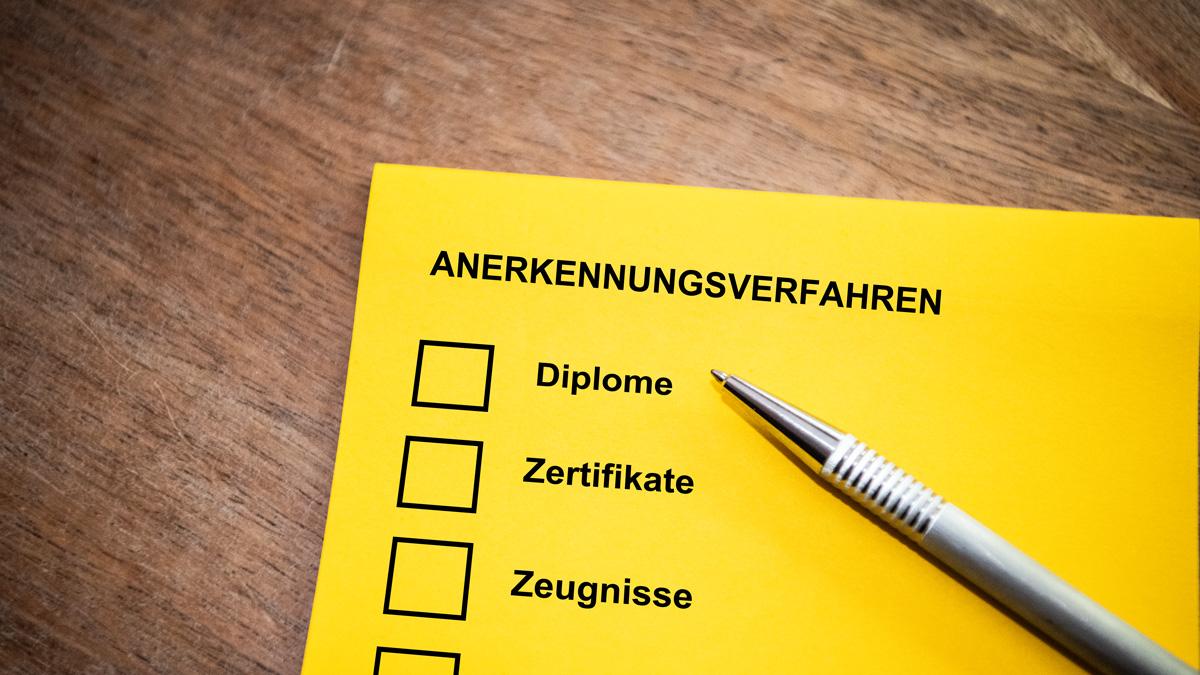
Various documents are required for recognition, such as diplomas, training certificates, or proof of professional experience. The competent authority uses these documents to assess the equivalence of the qualification.
If certain documents are missing, there are often alternative ways to demonstrate one’s skills—such as through exams, technical interviews, or practical work samples.
It is not always possible to provide all proof of training. People who do not have complete documentation—particularly those who have fled their home countries or face special personal circumstances—still have options for recognition.
In such cases, a so-called qualification analysis can be conducted. During this process, applicants demonstrate their professional skills in a practical setting—for example, through trial work, practical tasks, or technical interviews. Experts then evaluate the demonstrated knowledge and decide on full or partial recognition.
Upon completion of the process, applicants receive an official decision. Various outcomes are possible:
Full recognition
The foreign qualification fully corresponds to the German vocational qualification.
Partial recognition
Certain content or qualifications are still missing. These can often be supplemented through continuing education or adaptation measures.
Special measures for regulated professions
In some professions, additional courses, adaptation training, or exams must be successfully completed before the profession can be practiced.
No Recognition
If the differences between the foreign and German qualifications are too great and cannot be reconciled, recognition will be denied.
Simplified recognition procedures apply to skilled workers from EU and EEA countries as well as Switzerland. Some professions are automatically recognized within the European Union. These include, among others:
In addition, for certain professions, a European Professional Card can be applied for, which facilitates the recognition process within the EU.
The costs of the recognition process vary depending on the profession and the responsible authority. Fees often amount to several hundred euros. In addition, there are often costs for:
Under certain conditions, however, financial assistance or grants can be applied for—for example, through the Federal Employment Agency or various state-level support programs.
As a service and interpreting agency for Romanian clients, we provide reliable support throughout the entire recognition process in Germany.
Our support includes:
We help Romanian professionals successfully take advantage of their career opportunities in Germany and make the recognition process simpler and more understandable.
If you're dealing with bureaucracy, paperwork, or just not sure where to start, please contact us. Just let us know how we can help. We're here for you and ready to work together to find solutions.